
Best Q-switched laser machine for their office, it is essential to find one that will yield predictable, fast results for removing pigments from patients’ skin, fading tattoos and providing greater levels of skin rejuvenation. If you are considering options available in the market today there will be many terms that you will come across, such as “Pico Laser,” “Q-Switch ND YAG,” and,”best Q-Switch Laser Machine for Pigments.”
In this article, we outline what features differentiate one Q-switch Laser Machine from another, how a high quality Q-Switch Laser Machine leads to improved patient results, and why increasing numbers of dermatologists are becoming interested in the Picowave platform.
Features to Look for When Choosing the Best Q-Switch Laser Machine . To determine the best Q-Switch Laser Machine for your practice, we recommend finding a system that combines Energy Control, Flexibility in the Size of the Spot and Safety Features. An excellent Q-Switch ND YAG Laser should provide consistent nanosecond pulse output, with uniform energy distribution to the target while protecting surrounding tissue. Many offices now compare the technology of Pico lasers with the conventional Q-switches available today. The primary difference between the technologies is speed; the Pico technologies emit shorter pulses which may be more effective for specific tough-to-treat tattoos, while the traditional Q-switch systems generate nanosecond pulses. Ultimately, when choosing a Q-Switch Laser Machine to treat patients’ skin, the best Q-Switch Laser Machine is the one that treats the majority of your patients’ conditions.
Reasons for Considering Pico Lasers versus Q-Switch Laser Technology
While there are positive attributes associated with both pico lasers and Q-switched laser technologies, their application ranges differ. The pico laser will allow for faster photo-acoustic fragmentation of types of pigments and consequently, it will require fewer treatment sessions compared to other pico devices. Although proper use of an ND YAG laser (a type of Q-Switch laser) will provide better results when dealing with saturated inks (e.g., black and dark blue). Therefore, when it comes to choosing the right Q-Switch laser, look at the amount of user comfort during treatment, how well the artist controls the pulses, and the wavelength you have available for pigment work: 1064 nm and 532 nm are currently the two most common wavelengths used throughout the entire laser industry.
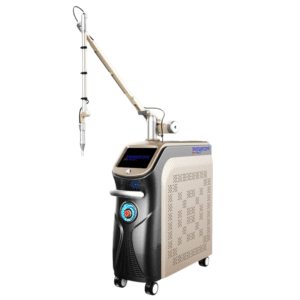
What is often considered the best of the best Q-switch laser machine(s), will usually be the one that allows the clinician the greatest flexibility. A multi-wavelength Q-switch ND Yag allows the operator to switch rapidly between wavelengths of 1064 nm and 532 nm, allowing for more specific and tailored treatments for both dermal and epidermal pigmentation. Additionally, many clinics that offer more advanced treatment(s) may later incorporate a pico laser for the treatment of more difficult resistant pigmentation or scarring. Branding also plays an important role, as there are brands on the market such as Picowave(s), that have been evaluated and proved to have excellent Q-switched results and provide an easy-to-use product with adequate training and support for proper operation and maximum efficiency; therefore, in many environments, these types of products represent a legitimate contender for the best Q-switch laser machine award.
Patient outcomes and safety
Patient outcomes typically are dependent upon the operator’s ability to use the equipment correctly and the operator’s ability to select the most appropriate patient type(s) to receive treatment, as well as the level of reliability of the device. Using an absolute Q-switch ND Yag laser will provide greater flexibility to choose comfortable spot sizes and consistent fluence. With pigment treatment, in light of the operator’s ability to control treatment parameters, it is just as important the treatment is performed with a device labeled as either a pico laser or Q-switched. When evaluating the very best Q-switch laser machine for pigmentation, consider the manufacturer’s clinical evidence supporting the effectiveness of the device, the availability of training, and the manufacturer’s ability to provide assistance via post-market service — these factors will affect long-term results.
Picowave is an ideal device for clinics that are looking to purchase a high-quality, reliable Q-switch ND Yag laser with user friendly controls and excellent safety features. Many users have found that they are achieving greater efficiency in removing both epidermal and dermal pigments while experiencing fewer side effects. Picowave’s design offers the ideal blend of a Q-switch laser that provides results without requiring extensive training, which makes it an excellent alternative to older Q-switch technology as well as a great choice when considering a pico technology system.
When purchasing a Picowave Q-switch laser it is important to remember the following:
Request for demonstrations to compare the differences between how the two different types of pico lasers operate during typical cases.
Gather documentation (evidence) of the machine’s capabilities to remove certain pigments and fade tattoos based on real-life experiences.
When considering service contracts, it is critical to know that the best Q-switch laser will only be successful when backed by a reputable manufacturer, and in this area of post-sale support Picowave consistently scores highly.
In addition, it is important to find a manufacturer who provides training programs. Manufacturers that provide specific training for your staff can minimize complications that can arise from improper use of the machine while significantly improving clinical outcomes.
To find the most appropriate Q-switch laser machine involves balancing technology (e.g., whether to select a picosecond laser or conventional Q-switch ND YAG laser), how you plan to market your product, as well as what level of after-sales support you need.
Many clinics that are interested in offering effective pigment clearing options have consistently identified Picowave as one of the best Q-switch laser systems available for that purpose. Clinical practitioners have commented on the versatility of Picowave and the extensive support provided by its manufacturers.
FAQs
1. What is the difference between a pico laser and a Q-switch ND YAG laser?
In general, a pico laser produces shorter pulses in a fraction of a second (pico) and therefore generates a stronger than usual photoacoustic response to specific pigments. Conversely, the Q-switch ND YAG laser produces longer (nanosecond) pulses and is considered to be very effective with respect to many types of tattoo inks, dermal pigmentations, etc.
2. What’s best for treating melasma: Pico vs. Q-switch ND YAG lasers?
Melasma should be understood as a complex condition, and practitioners differ in terms of how cautious they wish to be in their approach to treating this pigmentary disorder. Therefore, while treating melasma can be accomplished with a Q-switch ND YAG laser carefully, using a pico treatment can also be helpful in specific cases. When deciding which of the two systems to use, we recommend looking for the best performing system based upon research and/or your clinician’s experience.
3.How Can I Determine Which Q-Switch Laser Machine Is Best For My Clinic?
The best way to determine which machines will work best for your clinic’s needs is to test them during demos, evaluate clinical research studies and evaluate the available training and services for each. The Picowave is an example of a Q-Switch laser that provides both exceptional performance and excellent support.
4.Are Q-Switch Laser Treatments Safe for All Skin Types?
Q-Switch Laser Treatments are effective for a large number of skin types; however, darker skin types may need to have the power settings adjusted in order to minimise the likelihood of pigmentary complications.
5.Will The Best Q-Switch Laser Machine Be Effective For Removing Coloured Tattoos?
A multi-wavelength Q-Switch Nd Yag Laser will effectively treat many different colours of tattoos. Some colours, however, have shown a better response to Pico or a combination of methods of removal.